
The Cheapest Welder Isn't the Cheapest Welder
Posted by Banditos Incorporated on 2026 Jun 18th
How production managers get burned chasing sticker price, and the five specs that actually decide what a welding system costs you.
At Banditos, we talk to production managers every week who are weighing welding equipment decisions. The ones who get burned almost always have one thing in common: they optimized for sticker price instead of total value.
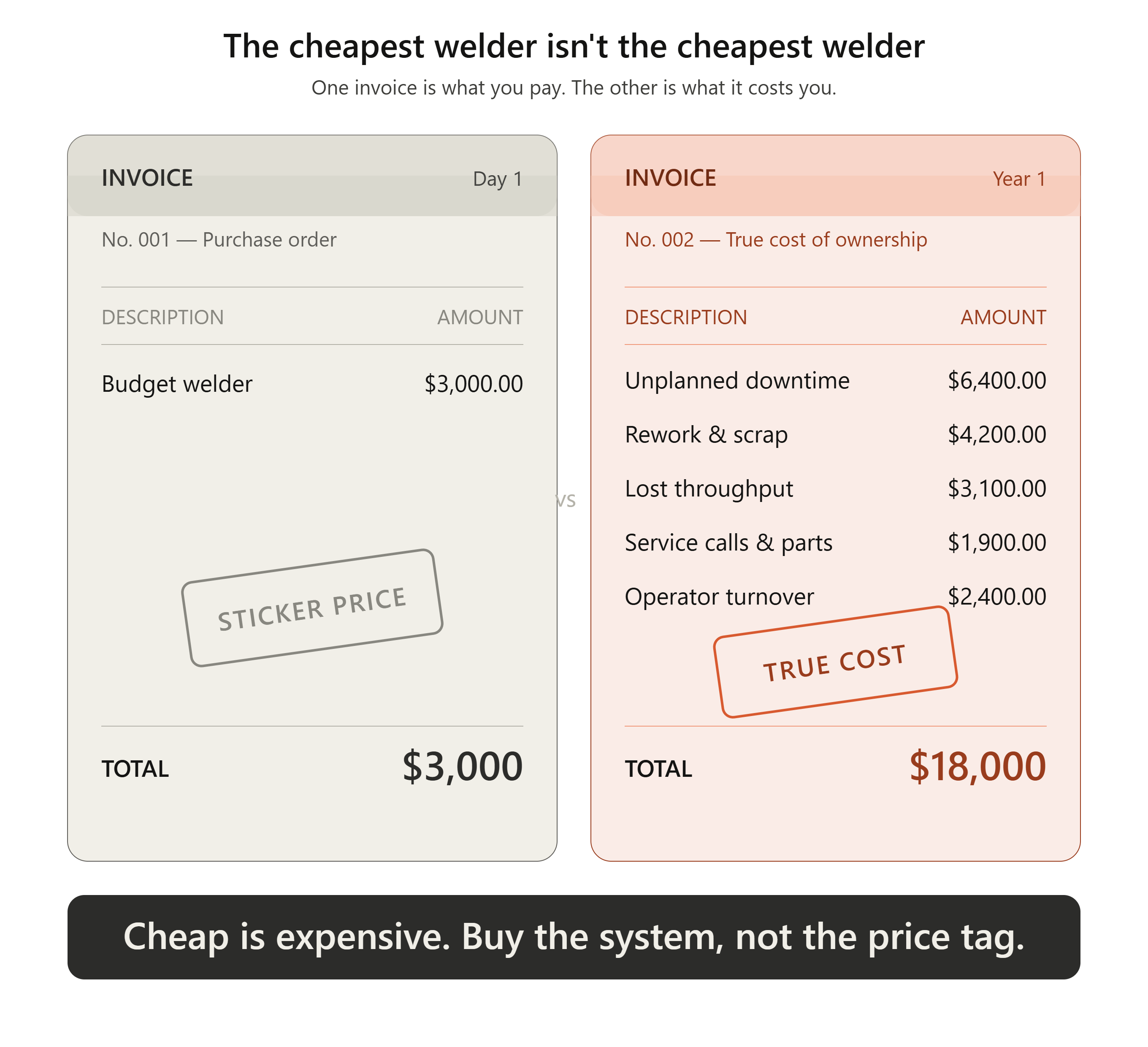
The cheapest welder on the quote sheet is rarely the cheapest welder on the shop floor. One invoice is what you pay. The other is what it costs you over the next decade in downtime, rework, service calls, and the people who walk out the door because the equipment fights them all day.
If you're spec'ing out your next welding system, here are five things that actually move the needle.
1. Duty Cycle and Reliability
A machine rated for 60% duty cycle at your actual amperage is what delivers real throughput. Read the spec sheet carefully: can this welder run as hard as your team needs it to, all shift, without thermal cutouts dragging down your numbers?
The flip side matters too. Don't overestimate your needs and pay for more machine than you'll ever use, unless you're deliberately buying for future capacity. A high-output system like the Fronius Fortis 500 XT DUO earns its keep on long seams and thick material in high-volume production, where system availability is everything. Match the machine to the work, not to the brochure.
2. Arc Quality and Consistency
Better arc characteristics mean fewer defects, less grinding, and dramatically less rework. A premium power source often pays for itself in scrap reduction inside the first year.
And arc quality genuinely varies between machines. Fronius-developed processes like LSC (Low Spatter Control) and PMC (Pulse Multi Control) on the TPS/i platform exist specifically to stabilize the arc and cut spatter, which is exactly where rework and cleanup hours disappear. Cleaner arc, cleaner part, fewer touch-ups.
3. Serviceability and Parts Availability
When a machine goes down, how fast does it come back up? Local support, common consumables, and modular components matter. A bargain welder with a six-week parts lead time isn't a bargain. It's a production stoppage waiting to happen.
This is where buying from an authorized Canada-wide distributor changes the math. Genuine parts, real warranty backing, and someone who picks up the phone are worth more than a few points off the purchase price the first time a power module fails mid-run.
4. Operator Experience
Skilled welders are the hardest hire in manufacturing right now. Intuitive controls, lighter torches, better ergonomics, and clean interfaces reduce fatigue and help you keep your best people.
This isn't a soft factor. A welder who isn't fighting a heavy torch or a clunky menu lays down better beads, longer, with less burnout. Touchscreen setup in plain language, lighter PullMig torches, and stable arc control all add up to a person who stays. Replacing a good welder costs you far more than a comfortable one ever will.
5. Data and Connectivity
Modern systems capture weld parameters, flag deviations, and feed your quality systems. In 2026, if you're not collecting weld data, you're flying blind.
Platforms like Miller's Insight welding intelligence monitor every weld against preset limits and flag missed, under-, or over-welds in real time, then report cost, productivity, and quality data across the floor. Fronius offers the same visibility through documentation and data-logging options on the TPS/i. Weld data turns "we think quality is fine" into "we know it is," and that's the difference between catching a drift early and shipping a batch of scrap.
The Right Question
The right question isn't "What does this welder cost?"
It's "What will this system deliver in uptime, throughput, quality, and workforce satisfaction over the next decade?"
Cheap is expensive. Buy the system, not the price tag. Uptime, throughput, quality, and your people are where the real ROI lives.
Banditos is an authorized Canada-wide dealer for Fronius, Miller, and the lines that keep serious shops running. If you're spec'ing your next welding system and want to talk total cost of ownership instead of sticker price, reach out at banditosinc.com - Blue Collar Superstore. Built for the people doing the work.