
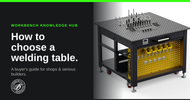
How to Choose a Welding Table: A Buyer's Guide for Shops and Serious Builders
Posted by Banditos Incorporated on 2026 Jun 23rd
A welding table is one of those purchases you only want to make once. Buy right and it becomes the anchor of your whole shop — the flat, square reference surface everything else gets built on. Buy wrong and you spend the next ten years fighting a warped top, a hole pattern nothing fits, or a table too light to hold a real job steady.
This guide walks through what actually matters when you're choosing one, in plain terms, so you can spend your money once and get back to work.
Start with the question: fixed or modular?
Before you look at a single spec, decide which kind of table you're buying.
A fixed (solid-top) table is exactly what it sounds like — a heavy, flat steel slab on a frame. No holes, no system. It's simple, tough, and cheaper up front. If you mostly do repair work, one-off jobs, and general fabrication where you clamp to the edges, a solid top is often all you need.
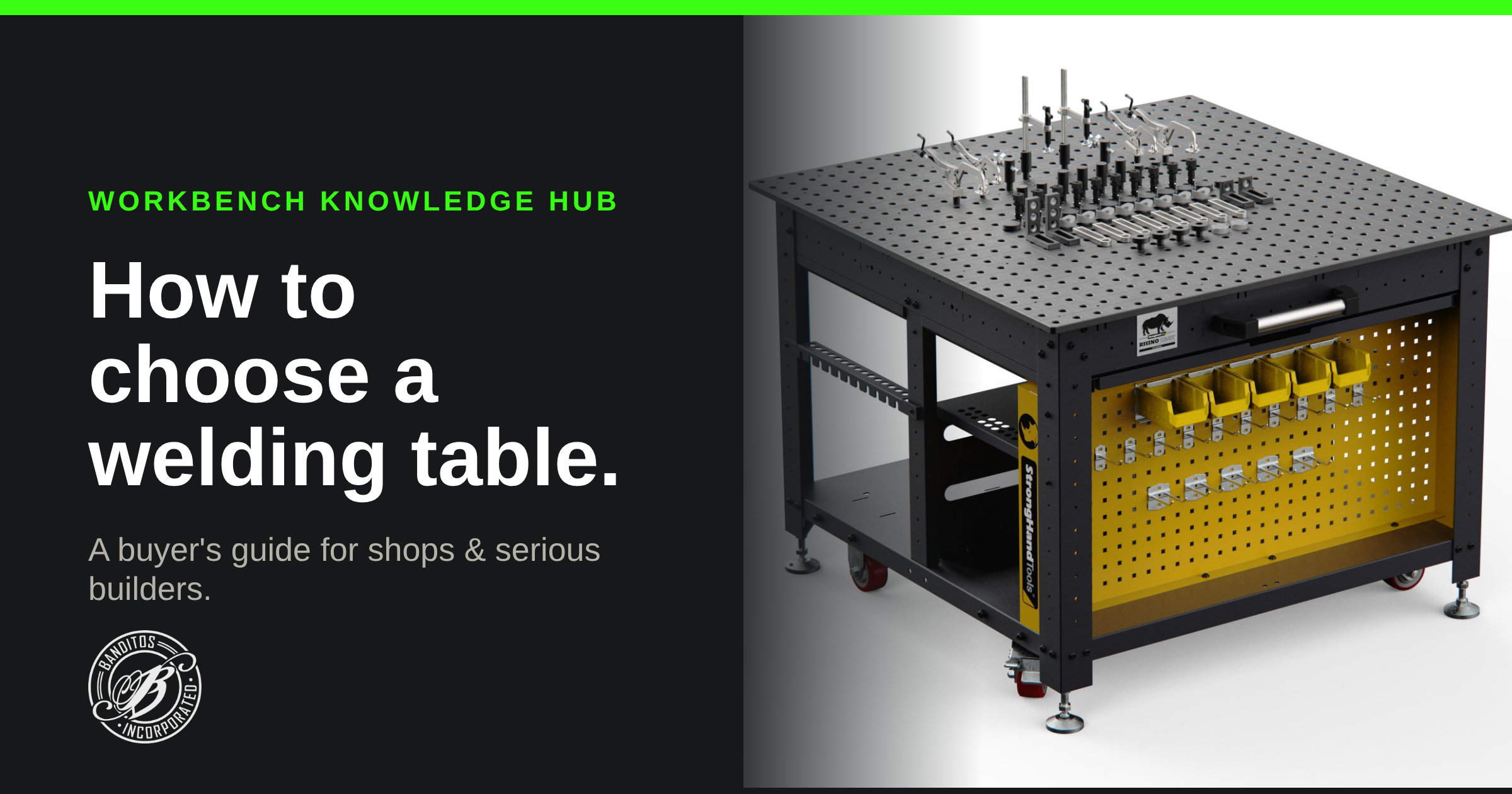
A modular fixturing table has a precise grid of holes drilled across the top (and usually the sides). Those holes accept clamps, stops, squares, and bolts that lock your workpieces exactly where you want them. This is the system that turns a table into a repeatable jig. If you build the same assembly more than once, weld anything that has to come out dimensionally accurate, or want to set up complex fixtures fast, modular pays for itself quickly.
Most shops that get serious end up wanting modular. The rest of this guide assumes you're at least considering one.
Hole size: the decision that locks you into a system
If you go modular, the single most important spec is hole diameter, because it determines every clamp, stop, and accessory you'll ever buy for that table. The two dominant standards are:
16mm — the metric standard used across most of the modern fixturing world. Huge accessory ecosystem, slightly finer and lighter-duty than 5/8", and the default for a lot of European-style systems.
5/8" — the North American workhorse size, common on BuildPro and similar tables. Heavy-duty clamps, widely available, and a natural fit if you're buying mostly North American gear.
Here's the thing to understand: 16mm and 5/8" are close but not interchangeable. Pick the one that matches the accessory system you want to live in, and commit. Switching later means re-buying clamps. When in doubt, think about which clamps and squares you already own or plan to buy, and let that drive the hole size — not the other way around.
Material and thickness: where cheap tables betray you
The tabletop has to stay flat under heat and weight, and that comes down to material and thickness.
Thin tops warp. When you lay a bead on a light tabletop, the heat distorts it, and a warped reference surface makes every job after it slightly wrong. A proper welding table uses a thick steel top — and the better ones go a step further with a hardened, plasma-nitrided, or treated surface that resists wear, corrosion, and weld spatter sticking to it.
You don't need the thickest top on the market for light work, but don't go too thin to save a few dollars — flatness is the entire point of a table, and it's the one thing you can't fix later.
Weight and rigidity: a table that moves is a table that lies
A welding table's job is to not move. If it rocks, flexes, or walks across the floor when you're wrenching a clamp down, your accuracy is gone.
Look for a heavy, well-braced frame. Heavier is generally better here, within reason for your space. If you need to reposition the table, look for one with locking casters rather than buying something light enough to shove around — light and accurate don't go together.
Size: buy for the job, plus a little
Tabletop size is a balance between the work you do and the floor space you have. A common mistake is buying too small to save money or room, then constantly running out of surface on bigger jobs.
A good rule: size for your typical largest job, then go one size up if the space allows. You'll grow into it. Modular systems also let you bolt tables together or add extensions later, so you're not fully boxed in — but starting with enough surface saves a lot of frustration.
Accessories: the table is just the start
With a modular table, the accessories are where the real productivity lives — and they're worth budgeting for from day one, not as an afterthought:
- Clamps and stops lock workpieces to the grid
- Fixturing squares hold dead-on 90s while you tack
- Welding magnets position steel hands-free at any angle
- Rest buttons, bolts, and brackets build out custom jigs
A bare table with no accessories is like a bench with no vise. Plan to buy a starter set of clamps and squares alongside the table so it's productive on day one.
A quick way to decide
If you want the short version, here's the decision path most builders land on:
- Repair shop or general one-offs, tight budget? A solid-top table is honest and tough. Start there.
- Building repeatable assemblies or anything dimensionally critical? Go modular.
- Going modular? Pick your hole standard (16mm or 5/8") based on the accessory system you want, get the thickest top you can reasonably afford, prioritize a heavy rigid frame, and size up if you have the room.
- Whatever you choose, budget for clamps and squares with it. The table is the foundation; the fixturing is what does the work.
Where Banditos comes in
We carry the welding table and fixturing systems serious builders actually trust — including Strong Hand Tools' BuildPro modular tables and the Fireball Tool square-and-fixturing ecosystem — along with the clamps, magnets, and squares that make them work. Everything is authorized, genuine, warranty-backed, and shipping Canada-wide.
Not sure which way to go? That's exactly the kind of question we're here for. Reach out and tell us what you build — we'll help you spec a setup that fits your shop and your budget.
Shop welding tables and fixturing at banditosinc.com
The Workbench Knowledge Hub is where Banditos puts trades know-how in writing — buying guides, FAQs, and straight answers for the people doing the work. Built by the trades, for the trades.